Thursday, December 27, 2012

Mami T-- Part 9

Women in those days did not wear pants or shorts; they wore long dresses with large bib aprons. When she arrived at the creek she would take off her apron and turn it around and tie the sash in front, and then bend over and reach through her legs and grasp the tail of the apron and bring it through and up and tucked it into the sash tied at her waist. Instant shorts!

Daddy told us that she was very frugal and hated to waste anything, especially time. As she walked along on her journey to and from the settlement she would usually knit.

A Spinning Wheel
She raised sheep on her farm as well as chickens, hogs, and milk cows.  And she had the mules for plowing the field. She saved the wool needed for her family when the sheep were sheared; then she sold the rest. She had a spinning wheel for spinning her own yarn.

In addition to farming she still had to cook the meals which were cooked on a wood burning stove or fireplace. She also had to do laundry by hand, harvest and prepare, can and preserve the food. She made her own lye soap which was the cleaning product of that time, and it was usually made from left over grease and lye or pot ash made from ashes.

I don’t remember the recipe or the process, but I know my Mother made it every so often in the old cast iron wash-pot when I was a little girl. And I would imagine that Mami T made it much in the same way.

There were cows to milk, chickens and livestock to feed, gather the eggs, chop the wood and bring it in, this was a chore she did herself till Tony was big enough to wield an axe.

And when the weather got cold the hogs were butchered, and the meat had to be processed and hung in the smokehouse to be cured.  The work was a never ending process, day in and day out, every day, and it was year after year.

I am quite sure she arranged her work schedule according to the seasons and the weather at the time. I know from daddies stories that when she plowed in the field she had to harness the mules, and she took the children to the field with her.

Emily was placed on a quilt pallet nearby and William H. (Tony) watched and tended her while Mami T plowed and Rody walked behind her and dropped the seeds as she plowed the rows. The others helped as soon as they were big enough to help.

A Woman Plowing
A Sun Bonnet
In my mind’s eye I can see her plowing in the fields, dressed in the long dress and a bib apron, and she is wearing a sun bonnet and brogans. Most southern women who worked in the fields with their husband’s; and most did; also made these bonnets to wear; to shade their eyes, and protect their hair and skin, especially the skin on the back of their necks; from becoming sun-burned.

Brogan
For those of you who might not know what brogans are; they are high-top shoes made of good leather, which lace up with either leather or string or possibly twine. They are heavy-duty shoes that wear like iron. There was no such thing as sneakers in those days!

Mami T-- Part 8

Can any of you imagine being left as she was in the mid 1800’s? Think about it, she was left a widow in the wilderness with three small children, no education, no job, no money, no welfare assistance, no Medicaid, and no food stamps; she was left with absolutely nothing except her children, her home and her land.

I am sure that she mourned the loss of her husband just as most any woman would, and I am certain she spent many long and lonely nights longing for the comfort of his arms holding her in the night seasons. As long as she knew that he was alive there was hope that he would return. But as soon as she received word of his death; that hope was gone!

Suddenly she was forced by circumstances far beyond her control to become the head of her household. She did not have much of a choice, she either had to give in to the circumstances, and she and her children would slowly starve to death. Or bite the bullet and become a survivor.

She had a warrior spirit, and did not wallow in self pity; she chose to deal with the hand that had been dealt to her by life, with grit, guts and fierce determination, and a tremendous amount of back breaking work!

She chose to do what she already knew how to do, and that was to farm her land herself with only her small children to help. A gigantic undertaking! Her father was a farmer, and she had grown up working in the fields, and so had her husband been a farmer and she had worked with him for many years.  She raised her children alone on her farm.

I am sure that her family helped as much as possible, but they had their own farms to work. Having been raised on a farm I can relate somewhat with the job she had on her hands, it is hard physical labor, and it is a job that is never finished.

One of the stories Daddy told about her was that she had to walk into the settlement to get supplies every so often. I think the settlement that she walked to back then; in time eventually became Graceville, Florida.

There were no baby sitters available in those days, and she could not take her children with her. The distance which was five to eight or ten miles was much too far, and she had to ford one or two creeks on the way to and from.

A Florida Black Bear
Mating Eastern Diamondback
Rattlesnakes
There were also the wild animals she had to consider that might be encountered along the way; black bear, alligator, panther, wild cats, wild hogs, diamond-back rattle snakes, etc. all were plentiful in the Panhandle in those days, and in order to make the trip she had to devise another plan to deal with this situation.

A Florida Panther
I hesitated for a bit about writing this story because there are some today who might consider the way she solved her situation to be child abuse. 

No matter what others think; I consider what she did to have been great wisdom on her part; in order for her and her children to survive in this raw harsh land and time; she did what she had to do!

And for those who might criticize; just remember this was light years (150 years ago), away; from the instant world that you live in today.

When she and William had built their house they had also dug a root cellar underneath the kitchen, and walled it in with logs; to store fruits and vegetables in, and it was quite spacious and had center posts to support the kitchen floor above. There was a trap door and steps from the kitchen down into the root cellar.

She would leave the children in the root cellar with plenty of food and water, and a thunder mug for nature calls.  Rody being the oldest was in charge till Mami T returned.

After she closed the trap door she rolled a big rock that was kept in the kitchen for this purpose over the door as an added measure of protection for her children; in case wild animals came to raid for food while she was gone.
I figure it took her quite possibly seven to eight or 10 hours at the very least to make the trip there and back.

She had made a knap sack with a shoulder strap that she wore crossed over one shoulder and around her neck to carry her supplies in.

Mami T-- Part 7

I learned from the ADAH researchers that he had not been killed in December of 1861, because there were Union records of his having been captured at Island 10, in April 1862. 

He was a Prisoner of War, and there are records of roll calls where his name is listed. He was exchanged in November 1862 at Aiken’s Landing near Vicksburg, Virginia. I have copies of these records.

He returned to his Company in Port Hudson, La. And there the trail goes cold. There is no record of his death in any manner, no hospital record, and no record of burial. No other records at all!

The fact is I have no idea of what happened to him. I did later find a discharge record for William McDuffey 1st Alabama Company I, Private.

Even though neither I nor the two Civil War researchers could find any record of his death; it had to have been accepted by the War Department that he had died somewhere, because Mami T began drawing a pension in 1909, at the rate of $120.00 per annum.

He never returned and was never heard from or about by the family again. I did ask the researchers how Mami T would have been notified and they told me that most likely it would have been word of mouth.

On her sworn affidavit which was filed in 1904 there was a place that she had to swear as to how long she had lived in Florida. The date that was typewritten in was May 15, 1824.

Since this could not even possibly have been a correct date, because she was born May 15, 1830; my thoughts are that whoever typed the paper up wrote the year in as 1824 where it should have been written May 15, 1842. I am sure it was a typo error!

And I believe that because she could nor read or write, and no one read it back to her that she was not aware that a mistake had been made before she made her mark. May 15, 1842 would have been her twelfth birthday and she most certainly would have remembered arriving in the Florida Territory on that date.

If this is correct; this then would make the Taylor family Florida pioneer’s; however no papers have ever been filed for a Pioneer Certificate by anyone in our family that I am aware of. Florida was still a Territory, and did not become a State until sometime in 1843.

Mami T-- Part 6

The day I received the copy of her application in the mail I was so excited I was beside myself! As I was reading her sworn affidavit I saw her mark, an X on all of the pages, and I realized that she could not read or write; this was something that I had never even thought about before.

The papers were so clear they looked like originals, but I knew they were copies, I reached out and touched her mark with one finger, and it became a spiritual experience for me, suddenly in that moment it seemed as if all the years just slipped away, and I was actually touching the hand of my gg grandmother; I began to weep.

I saw it so clearly in my mind’s eye. And in that moment I had such an ache in my heart, and I mourned the loss of her for the first time in my life.

It was so real to me, I had loved and admired her all of my life, and I had at just this moment come to realize the fact that I had never known her personally at all, but she had lived in my memories and in my heart since I was old enough to hear and remember daddy’s stories about her.

I felt such a peace wash through me; it seemed to me as if I had actually touched her hand. And I believe that I did in the spiritual realm.

Afterwards I read her application and all of the information she had at the time she filed. She stated that William was in 1st Alabama Company A, and that he was killed in Port Hudson, La. December 08, of 1861, and that his Captain had been William Truett.

Not having much information about my gg grandfather I began to search and dig. In the beginning I only had the 1860 Holmes County census record. His name on the census was spelled William McDuffee born September 1827, Georgia. There was no other information.

I then realized this was why my dad had never talked about him; he had never known him, and you never think or talk about people that you have never known.

William left for the War and he was never heard from again by any family members. This was long before my granddaddy Boss or my dad was even born.

On the very last page of the paperwork I had received from Tallahassee there was a small form from the War Department. It confused me because it sounded as though there had been two William McDuffie’s in 1st Alabama. I contacted ADAH (Alabama Department of Archives and History) I spoke with two of their researchers via email.

And there had been two, one was William A. McDuffie and he had been in 1st Alabama Old Company B. and he was from Eufaula, Alabama and their Unit was called ‘Eufaula Rifles’, he was an officer, and he was black.

The other was my gg grandfather William and his last name had been spelled McDuffey. He was in 1st Alabama Company I his Unit was called ‘Dale Avengers’ his Captain had been William Pruitt, and he was a private.

Mami T-- Part 5

I am certain that the land they purchased would have had to be cleared before they could even think about farming it, because in those days it was primarily a wilderness.

Civil War
Most likely the garden spot was the first to be cleared. Mami T worked alongside William to build a home and farm the land.  They had been married ten years and had three children before he enlisted in the CSA and left to fight in the Civil War.

Their first child was a daughter named Rhoda Ann, born in 1853, but she was always called Rody. Their second child was William Henry born in 1857 and he was called by several names; aliases that he called himself, that he became known to others by.  The third child was another daughter, and she was named Emily Margaret, born in 1860; she was named after Mami T’s sister Emily.

I learned during my search that William had also been involved in a long term and on-going relationship with another woman; her name was Candace French, and she was the daughter of Robert Emanuel and Elizabeth Leavins French, who were married in Thomas County, Georgia. Candace was born March 20, 1820 in Georgia.

I was thinking that since both women in William’s life had been born in Thomas County, Georgia, that maybe I could find him in Thomas County, as well. But sadly as of this date I have not found him on any census records except the 1860 Holmes County, record. I only have a three year window of his life to show that he had ever lived.

In the French family record shared with me by a descendant of their family it states that Candace had an on-going relationship with William H. McDuffie, and that they never married, and their children were, Samuel French born March 4, 1848, and Richard French born February 22, 1855. Their relationship is also recorded in the McDuffie Family records.

It had been common knowledge by all who knew them, and it was recorded in the histories of the families, so I assume it was an acceptable relationship for all concerned.

A Confederate Soldier
William enlisted in the CSA January 17, 1861 at Pensacola, Florida. He left behind two women who loved him, and between the two of them he left behind three sons and two daughters.

Mami T received information from a source that is yet unidentified that he was killed in December of 1861 in Port Hudson, Louisiana. Many years later I discovered that most of the information she had been given by others was wrong.

She filed an application for a Widow’s Pension in 1904. I ordered a copy of her application from Tallahassee, Florida, and at the same time I asked for a copy of William’s service record.

Mami T-- Part 4

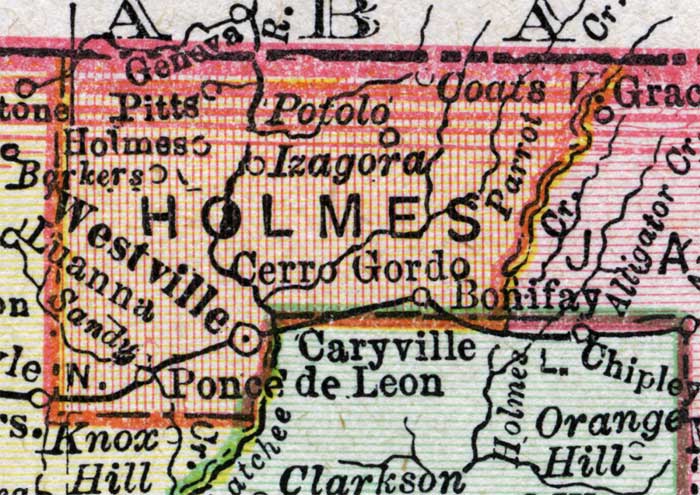
For a long time I did not know where they lived after they came to Holmes County. I had overheard my dad say in conversations with others that they had lived way down yonder on Wrights Creek. I came across a census record where the Post Office listed for them was Cerro Gordo, which is on the west side of the Choctawhatchee River.

Cerro Gordo was at one time many years ago the County seat of Holmes County. And Wrights Creek is a beautiful clear water creek which empties into the Choctawhatchee River south of Cerro Gordo. I am still not sure of the exact location of where they lived, but it was in this area.

According to historical records this area was where Creeks and other Native Americans gathered after being chased out of Alabama and Georgia. 

Holmes County, Holmes Creek and Holmes Valley are named after Creek Chief Holmes who came to this area after the Creeks were defeated at Horseshoe Bend in 1814.

Sometime after November 28, 1842 ~ a Creek village was found and wiped out by the local militia somewhere on Wrights Creek. They killed twenty-two Creeks and took no prisoners. It was considered a massacre even by the local white settlers. Very little was written about it.

The Taylor’s lived on Wright’s Creek for quite some time, for about 15 years; before James acquired land, the first land purchased was 120.04 acres somewhere near what is now known as Millers Crossroads on December 01, 1857. And in April 1860 he purchased an additional 199.95 acres.

I am not sure either of where and how Mami T and my gg grandfather William H. McDuffie met, but I would certainly love to know that story! She and William were married in November of 1851 in Bonifay, Florida according to the papers I have. I do not have their marriage record; I only have the sworn affidavit paperwork that she filed at a much later date.

After they married they too acquired land which was also located near Miller’s Crossroads. One of my cousins who still lives in the area knows where their house was located she remembers seeing it when she was a little girl. She told me the next time I am up that way she will show me where it stood.

In trying to find the location of the property I called the courthouse in Bonifay. The lady I spoke with told me that even though I had, and gave her the legal description; she could not give me the exact location unless I know the names of the present owners, but she could give me a general location. I ordered a map of Holmes County and she was kind enough to mark the general location on the map for me.

On some of the paperwork their Post Office was given as Potolo Florida, and even though I was born and raised in Holmes County this one caused me to scratch my head. I had never heard of it, I was able to find it on an 1900 map of the Panhandle!


I have since spoken with a man, Mr. James Williams who lives in Bonifay, and he told me exactly where it was located. His great grandparents John J. and Elizabeth Whitaker Perkins were the Postmaster and Postmistress of the Potolo Post Office.  It was located in their home and is about three or four miles southeast of Millers Crossroads.

Friday, December 21, 2012

Mami T -- Part 3

I have not been able to nail down yet the exact year that he left South Carolina, but I did find some records in Thomas County Georgia, where James lived for several years before migrating on down to North West Florida.  

In an 1850 census of Holmes County, Florida it gives his age as 50 years old, the census was taken in Division 3, Holmes Florida.

His wife is listed as Evelina, 34 years old. My gg grandmother Charity (Mami T) is 19 years old and living at home. Jasper the oldest son is 17, Henry is 15, Nancy is 13, Wilson is 11, Emily is 8 years, and Zachariah is a 7 month old baby.

I thought at the time when I first looked at this census record that Evelina was the mother of Charity (Mami T). And then I received an email from a lady who was also doing research on the same Family, and she told me that she thought that James had been married to a woman by the name of Tempe Faircloth before he married Evelina.

I checked some census records in Thomas County, Georgia and I found James Taylor listed on a census there, and if I am not mistaken the year was 1840. There were some small children in the household. Only the head of the households were listed by name in those early census records.

I searched the old marriage records of Georgia and found a marriage record for James Taylor married Tempe Faircloth March 30, 1828 in Thomas County, Georgia. There are no other records that I have been able to find about Tempe, but I believe that she is the mother of Charity, Jasper, Henry and Nancy.

I do not know what became of Tempe, but most likely she died, and was buried in Thomas County although I have found no record of that. It is quite possible that she died in childbirth when Nancy was born in 1837 or soon after. But since I have found no records to that effect I am just guessing. 

There is another marriage record for James Taylor married Aveline Faircloth October 04, 1838. There are also the same marriage records for both marriages in Terrell County, Georgia. This is a mystery I can't explain.

The lady that I had corresponded with told me that in her Family Bible Records her name is spelled Evelina. The spelling of her name is different on each census record, and it is believed by the family that she was the younger sister of Tempe.

I am also not sure of the exact time they left Thomas County and migrated on down to the Florida Territory which this area later became Holmes County, Florida. And I am not exactly sure of the date of their arrival, but I am pretty sure it was in May of 1842. I will explain later in the story the reason I feel certain this was the time when they arrived.

Wilson was born in 1839 in Thomas County, and Emily was the first child born in Holmes County, Florida. And Florida was still a Territory at this time.

I have not as yet found the date of Emily’s birth, but she was born in 1842 in the Florida Territory. Also listed on the 1850 census is Zachariah Jack who is seven months old.  Later there were two other children born, Sarah and Rachel Taylor.